Sunday, January 9, 2022

Webb space telescope deployment complete

08/01/2022

ESA / Science & Exploration / Space ScienceWebb
Today the James Webb Space Telescope team successfully fully deployed its iconic 6.4-metre, gold-coated primary mirror, completing the final stage of all major spacecraft deployments to prepare for science operations.

“The successful unfolding of the Webb telescope has been a complex but impressive engineering masterpiece. On behalf of ESA, I want to sincerely congratulate our colleagues at NASA for this achievement. Webb is an international partnership led by NASA, where ESA is providing key contributions in the form of instruments, science teams and, very importantly, a successful launch on Christmas Day from the European Spaceport in Kourou. I am grateful to NASA, CSA and our European team including CNES, Arianespace and ArianeGroup for this excellent cooperation,” says Josef Aschbacher, ESA Director General.

Read the full release online at: hhttps://www.esa.int/Science_Exploration/Space_Science/Webb/Webb_deployment_complete

Wednesday, January 5, 2022

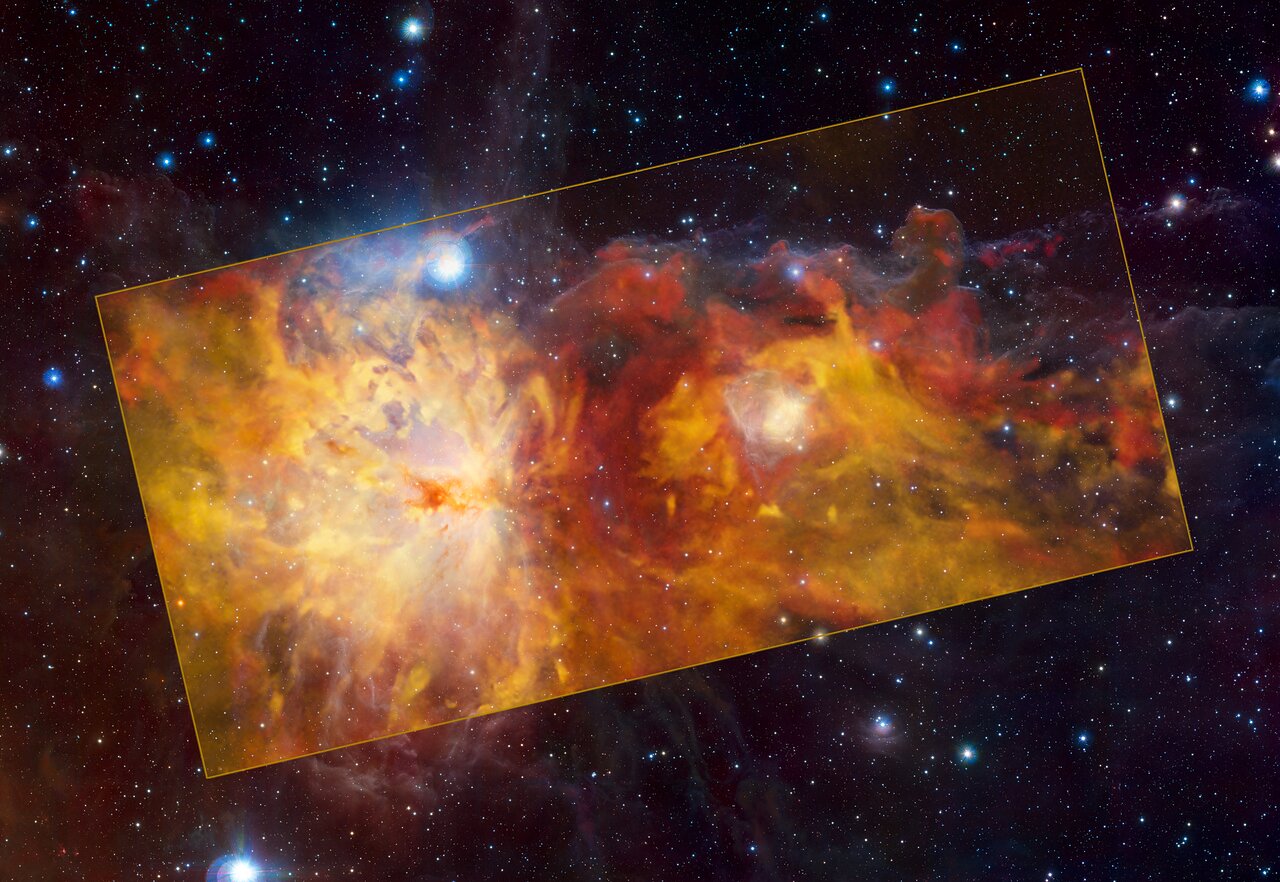
Orion’s fireplace: ESO releases new image of the Flame Nebula

Orion offers you a spectacular firework display to celebrate the holiday season and the new year in this new image from the European Southern Observatory (ESO). But no need to worry, this iconic constellation is neither exploding nor burning. 

The “fire” you see in this holiday postcard is Orion’s Flame Nebula and its surroundings captured in radio waves — an image that undoubtedly does justice to the nebula’s name! It was taken with the ESO-operated Atacama Pathfinder Experiment (APEX), located on the cold Chajnantor Plateau in Chile’s Atacama Desert.


See the full press release and associated paper online at: https://www.eso.org/public/news/eso2201/?lang.

The observations mentioned in this press release are presented in a paper accepted for publication in Astronomy & Astrophysics.

The team is composed of Th. Stanke (European Southern Observatory, Garching bei München, Germany [ESO]), H. G. Arce (Department of Astronomy, Yale University, New Haven, CT, USA), J. Bally (CASA, University of Colorado, Boulder, CO, USA), P. Bergman (Department of Space, Earth and Environment, Chalmers University of Technology, Onsala Space Observatory, Onsala, Sweden), J. Carpenter (Joint ALMA Observatory, Santiago, Chile [ALMA]), C. J. Davis (National Science Foundation, Alexandria, VA, USA), W. Dent (ALMA), J. Di Francesco (NRC Herzberg Astronomy and Astrophysics, Victoria, BC, Canada [HAA] and Department of Physics and Astronomy, University of Victoria, BC, Canada [UVic]), J. Eislöffel (Thüringer Landessternwarte, Tautenburg, Germany), D. Froebrich (School of Physical Sciences, University of Kent, Canterbury, UK), A. Ginsburg (Department of Astronomy, University of Florida, Gainesville, FL, USA), M. Heyer (Department of Astronomy, University of Massachusetts, Amherst, MA, USA), D. Johnstone (HAA and UVic), D. Mardones (Departamento de Astronomía, Universidad de Chile, Santiago, Chile), M. J. McCaughrean (European Space Agency, ESTEC, Noordwijk, The Netherlands), S. T. Megeath (Department of Physics and Astronomy, University of Toledo, OH, USA), F. Nakamura (National Astronomical Observatory, Tokyo, Japan), M. D. Smith (Centre for Astrophysics and Planetary Science, School of Physical Sciences, University of Kent, Canterbury, UK), A. Stutz (Departmento de Astronomía, Facultad de Ciencias Físicas y Matemáticas, Universidad de Concepción, Chile), K. Tatematsu (Nobeyama Radio Observatory, National Astronomical Observatory of Japan, National Institutes of Natural Sciences, Nagano, Japan), C. Walker (Steward Observatory, University of Arizona, Tucson, AZ, US [SO]), J. P. Williams (Institute for Astronomy, University of Hawai‘i at Manoa, HI, USA), H. Zinnecker (Universidad Autonoma de Chile, Santiago, Chile), B. J. Swift (SO), C. Kulesa (SO), B. Peters (SO), B. Duffy (SO), J. Kloosterman (University of Southern Indiana, Evansville, IN, USA), U. A. Yıldız (Jet Propulsion Laboratory, California Institute of Technology, Pasadena, CA, USA [JPL]), J. L. Pineda (JPL), C. De Breuck (ESO), and Th. Klein (European Southern Observatory, Santiago, Chile).

APEX is a collaboration between the Max Planck Institute for Radio Astronomy (MPIfR), the 


Tuesday, August 10, 2021

A New Window on Rising Seas

<h2>From NASA’s Sea Level Change Team</h2> 


The NASA Team has created a sea level projection tool that makes extensive data on future sea level rise from the Intergovernmental Panel on Climate Change (IPCC) easily accessible to the public – and to everyone with a stake in planning for the changes to come.

Pull up the tool’s layers of maps, click anywhere on the global ocean and coastlines, and pick any decade between 2020 and 2150. 

The tool, hosted on NASA’s Sea Level Portal, will deliver a detailed report for the location based on the projections in the IPCC’s Sixth Assessment Report, released on Aug. 9, which addresses the most updated physical understanding of the climate system and climate change.

Wednesday, August 4, 2021

CFP: Thermosense: Thermal Infrared Applications XLIV

Call For Papers by 6 October 2021 For DCS 2022


Conference Chair: Arantza Mendioroz, Univ. of the Basque Country (Spain)

Conference Co-Chair: Nicolas P. Avdelidis, Cranfield Univ. (United Kingdom)

Program Committee: Paolo Bison, Consiglio Nazionale delle Ricerche (Italy); Michael C. Borish, Oak Ridge National Lab. (United States); Douglas Burleigh, La Jolla Cove Consulting (United States); Terry Clausing, Drysdale and Associates, Inc. (United States); Fred P. Colbert, Colbert Infrared Services (United States); Jaap de Vries, FM Global (United States); Giovanni Ferrarini, Istituto per le Tecnologie della Costruzione (Italy); Sheng-Jen (Tony) Hsieh, Texas A&M Univ. (United States); Timo T. Kauppinen, Arctic Construction Cluster Finland (Finland); Dennis H. LeMieux, Siemens Power Generation, Inc. (United States); Fernando López, TORNGATS (Canada); Monica Lopez Saenz, IRCAM GmbH (Germany); Xavier P. V. Maldague, Univ. Laval (Canada); Junko Morikawa, Tokyo Institute of Technology (Japan); Gary L. Orlove, Thermal Imaging Consultant (United States); Beate Oswald-Tranta, Montan Univ. Leoben (Austria); G. Raymond Peacock, Temperatures.com, Inc. (United States); Ralph A. Rotolante, Vicon Enterprises Inc. (United States); Andres E. Rozlosnik, SI Termografía Infrarroja (Argentina); Morteza Safai, The Boeing Co. (United States); Takahide Sakagami, Kobe Univ. (Japan); Steven M. Shepard, Thermal Wave Imaging, Inc. (United States); Sami Siikanen, VTT Technical Research Ctr. of Finland (Finland); Gregory R. Stockton, Stockton Infrared Thermographic Services, Inc. (United States); Gary E. Strahan, Infrared Cameras, Inc. (United States); Vladimir P. Vavilov, National Research Tomsk Polytechnic Univ. (Russian Federation); Catherine R. Ward, General Atomics Aeronautical Systems, Inc. (United States); Joseph N. Zalameda, NASA Langley Research Ctr. (United States).


Read the full Call online at: https://spie.org/SI22/conferencedetails/thermosense?enableBackToBrowse=true


Saturday, July 3, 2021

Major Ocean-Observing Satellite Providing Science Data


After six months of check-out and calibration in orbit, the Sentinel-6 Michael Freilich satellite made its first two data streams available to the public on June 22. 

It launched from Vandenberg Air Force Base in California on Nov. 21, 2020, and is a U.S.-European collaboration to measure sea surface height and other key ocean features, such as ocean surface wind speed and wave height.

Read the full article online at: https://sealevel.nasa.gov/news/220/major-ocean-observing-satellite-starts-providing-science-data/?utm_source=newsletter&utm_medium=email&utm_campaign=monthly_newsletter.


Increasing the accuracy of your temperature measurements.

Monitor Newsletter at Windmill Software ( https://www.windmill.co.uk/ ) regularly publishes useful articles related to measurement, control,...